Mug Warmer Safety: What Auto Shutoff, ETL, and UL Listings Actually Mean
A specs-based look at the safety features that exist on mug warmers — auto shutoff, electrical certifications, thermal cutoffs — and what they actually protect against.
HUMAN REVIEW REQUIRED. This article covers electrical product safety topics. Per the site's AI Content Compliance Guardrails, all safety-related content must be reviewed by a human editor before publication. Treat the body as a draft, not a final published version, until the humanReviewStatus is updated to approved.
The safety question on a mug warmer is real. It's a heating element plugged into a wall for hours at a time, often unattended, often with coffee spilled on or near it. The good news: the product category has a small number of well-understood safety features that, when present, address most of the failure modes. The hard part is knowing which features are real and which are marketing.
This is the feature-by-feature breakdown.
What can actually go wrong with a mug warmer
Three failure modes cover most of the real-world risk:
- Continuous operation without supervision. A warmer left on indefinitely, possibly with a wet mug or a spilled liquid. The risk is heat damage to the surface under the warmer, or to the mug if it's plastic.
- Electrical fault in the heating element. A short circuit, a damaged cord, a manufacturing defect. The risk is shock or fire.
- Coffee spill on or near the electronics. A spill that reaches the heating element or the cord. The risk is short circuit or scalding from a broken mug.
Every safety feature on a mug warmer is addressing one of these three.
Auto shutoff
The single most important safety feature on a plate warmer. Auto shutoff cuts power to the heating element after a fixed period of continuous operation.
What the standards don't require: there's no US federal regulation that mandates auto shutoff on a mug warmer. It's a feature manufacturers choose to add.
What the typical ranges are:
- 4 hours: the most common in the budget-mid segment. Covers a full desk session plus margin. The Cosori is 4 hours.
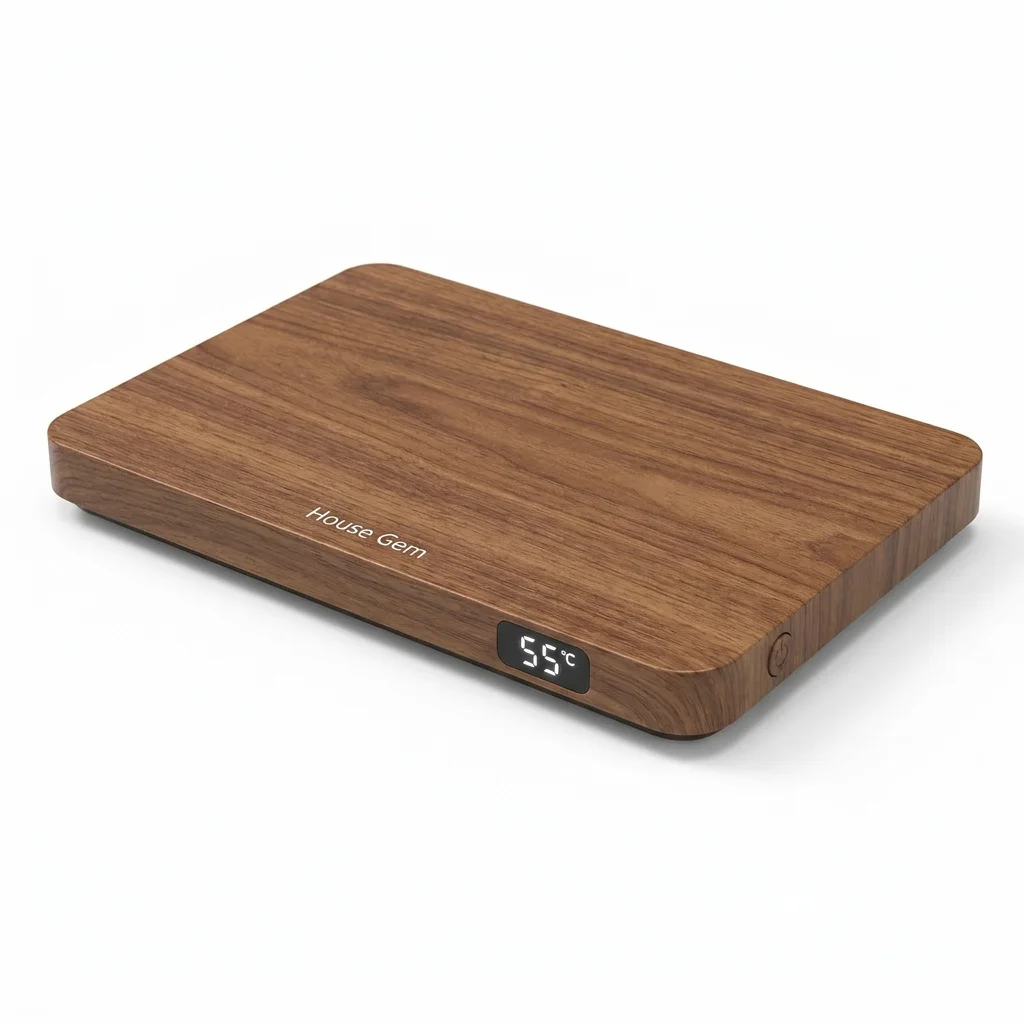
- 6-12 hours: the mid-tier and up. The House Gem 36W is 2-12 hours, configurable.
- No auto shutoff: a small number of budget warmers ship without. The Mr. Coffee Mug Warmer is one. The risk is that the user has to remember to turn it off. The recommended workaround is to plug it into a smart plug with a 4-hour timer.
What auto shutoff does: removes the "I forgot to turn it off" failure mode. If the warmer runs unattended for 12 hours with no auto shutoff, the plate is at temperature the entire time, the surface under the warmer is being heated for 12 hours, and any spill is being slowly cooked. Auto shutoff cuts that off.
What auto shutoff doesn't do:
- It doesn't address a damaged cord. A short in the cord is a problem whether the warmer is on for 30 minutes or 4 hours.
- It doesn't address an electrical fault in the element. The element failure would typically manifest as a non-working warmer, not a safety issue.
- It doesn't address spills that reach the element during operation. A spill mid-session is still a spill, with or without auto shutoff.
Practical recommendation: buy a warmer with auto shutoff. The price difference is small (the Cosori is in the same price tier as the Mr. Coffee and has auto shutoff). If you buy a warmer without auto shutoff, use a smart plug.
Electrical certifications (ETL, UL, CE)
Third-party electrical safety certifications exist for small appliances. The relevant ones in the US are:
- UL (Underwriters Laboratories) — the most-recognized US safety certification mark.
- ETL (Edison Testing Laboratories) — an equivalent certification, recognized by OSHA as meeting the same standards as UL.
- CE (Conformité Européenne) — the European certification. Indicates compliance with EU safety standards, but is not a US certification.
What the certification means: the product has been tested by an independent lab against a published safety standard. For small heating appliances, the relevant standard is UL 499 (or the equivalent ETL-listed standard). The test verifies:
- The element does not overheat under normal use
- The housing does not exceed safe touch temperatures
- The electrical insulation is adequate
- The cord and plug are rated for the current draw
- The product does not present a fire or shock hazard under fault conditions
What the certification does not mean:
- It does not mean the product is "lifetime safe" or "approved for any use." It means the product, as designed and tested, meets the standard.
- It does not mean the product cannot fail. Any electrical product can fail; certification is about reducing the probability and ensuring the failure mode is safe.
- It does not cover misuse. If you submerge the warmer, drill a hole in the housing, or modify the cord, the certification does not apply.
How to tell if a product is certified: the certification mark (UL, ETL, CE) is on the product, the packaging, and the spec sheet. Some manufacturers list it in the title (e.g., "Maestri House ETL Listed Coffee Mug Warmer"). Others bury it. If the spec sheet doesn't mention a certification mark, the product may be uncertified — and uncertified does not mean unsafe, but it does mean the manufacturer didn't pay for the test.
Practical recommendation: prefer products with a UL or ETL mark. They're not meaningfully more expensive, and they're the only products whose safety claims have been independently verified. The Maestri House warmer is one example with explicit ETL listing.
Thermal cutoff / overheat protection
Some warmers have an internal thermal cutoff: if the plate temperature exceeds a safe threshold (typically 200°F), the element cuts off automatically. This is a different feature from auto shutoff, which is time-based.
What it addresses: the "fault condition" where the auto shutoff fails, the user has placed the warmer on an insulating surface, or some other condition has caused the plate to overheat.
What it doesn't address: a thermal cutoff is a backup to the auto shutoff, not a substitute. If a product has a thermal cutoff but no auto shutoff, the thermal cutoff is there to catch the failure mode that auto shutoff would have caught first.
How to tell if a product has one: rarely listed in marketing materials. The spec sheet may mention "thermal protection" or "overheat protection" in the fine print. If the spec sheet is silent, the product may or may not have one.
What the "UL listed" mark actually looks like
UL listed products have a UL mark in a circle, with the word "LISTED" beneath, and a control number. ETL products have an ETL mark in a circle, with "Intertek" or "ETL" beneath.
A "CE" mark on a product sold in the US is a self-declared mark and is not a third-party certification. The CE mark is meaningful for products sold in the EU. In the US, "CE" on the product is sometimes a "China Export" mark, which is unrelated to European Conformity. This is a real source of confusion.
For US buyers, look for UL or ETL. For EU buyers, look for CE.
Spill behavior
Every plate warmer on the market is, to some degree, spill-resistant. The plate is sealed to the housing, and the electrical components are below the plate. A small spill (a few drops) is contained.
A large spill (the mug tips over and pours) is more than most warmers are designed for. The liquid reaches the seam between the plate and the housing, the bottom of the housing, the cord entry point. The risk varies by warmer:
- Sealed plate warmers (most modern designs) have a gasket between the plate and the housing. A spill that doesn't overflow the plate is contained.
- Open-bottom warmers (some older or cheaper designs) have the electronics exposed from below. A spill that reaches the bottom is a real problem.
Practical recommendation: if you spill, unplug the warmer before you clean it. Don't wipe a spill on a plugged-in warmer, even with a dry cloth — the spill may have reached an area where wiping spreads it. Unplug, then clean.
Putting it together
For a desk worker considering a mug warmer, the safety-relevant decisions in priority order are:
- Does it have auto shutoff? Yes/No. If no, use a smart plug.
- Is it UL or ETL listed? Yes/No. If yes, the certification is third-party verified.
- Does the spec sheet mention thermal cutoff / overheat protection? Nice to have, not required.
- Is the spill behavior documented? The manufacturer should describe what happens if the unit is tipped or spilled on.
For most users, the first two questions are the only ones that matter. A 4-hour auto shutoff plus a UL or ETL mark is the standard for a safe everyday warmer.
The Cosori, House Gem 36W, and Maestri House all meet both criteria. The Mr. Coffee meets neither — it has no auto shutoff and is not in the ETL list. Use it with a smart plug.
What to do if a warmer fails
Three failure modes that mean stop using immediately:
- Visible damage to the cord or plug. Cracking, fraying, discoloration, bent prongs. The cord is the most likely failure point.
- The plate doesn't heat consistently. A working plate either heats or doesn't. A plate that heats intermittently is a sign of internal damage.
- The auto shutoff stops working. If the warmer was supposed to shut off after 4 hours and didn't, the timer mechanism is broken. Stop using it on unattended basis.
For a warmer that trips a breaker, sparks, or smokes: unplug, don't use again, dispose.
Methodology: AI-assisted editorial assessment based on manufacturer specifications, published electrical safety standards (UL 499, EN 60335), and aggregated verified-purchaser reviews. This is a safety topic — review by a qualified human editor is required before publication per the site's AI Content Compliance Guardrails. We do not perform hands-on testing. See our editorial policy for how we work.