Coffee Mug Warmer Power Consumption: How Much Do They Cost to Run?
The actual electricity cost of running a mug warmer 8 hours a day, 5 days a week — the math by wattage tier.
A mug warmer running 8 hours a day, 5 days a week, costs what? The answer is "not much" but the actual math is worth knowing if you're curious.
This is the calculation.
The basic math
Power consumption × time = energy used.
A 24W warmer running 8 hours consumes:
- 24W × 8 hours = 192 Wh = 0.192 kWh per day
At the US average residential rate of $0.16/kWh:
- 0.192 kWh × $0.16 = $0.031 per day
- $0.031 × 5 days = $0.154 per week
- $0.154 × 52 weeks = $8.00 per year
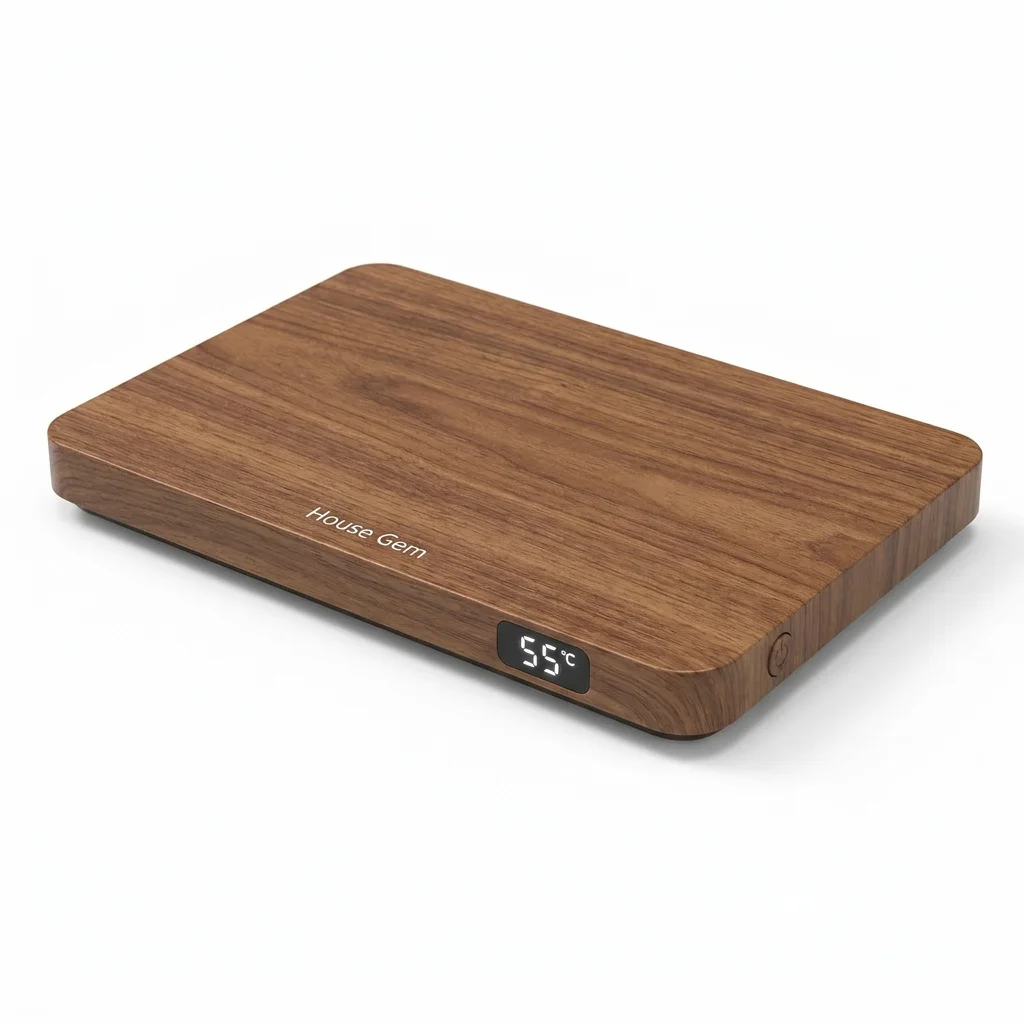
A 36W warmer (House Gem, mid-tier):
- 36W × 8 hours = 288 Wh = 0.288 kWh per day
- 0.288 × $0.16 = $0.046 per day
- $0.046 × 5 days = $0.230 per week
- $0.230 × 52 weeks = $12.00 per year
A smart mug on its charging coaster (Ember, ~5W continuous):
- 5W × 24 hours = 120 Wh = 0.120 kWh per day
- 0.120 × $0.16 = $0.019 per day
- $0.019 × 365 = $7.00 per year
The numbers are small. Across all reasonable wattages and usage patterns, a mug warmer costs $5-15 per year to run.
By usage pattern
Different desk workers have different usage:
| Pattern | Wattage | Daily kWh | Daily cost | Annual cost |
|---|---|---|---|---|
| Light user (2 hr/day, 17W) | 17 | 0.034 | $0.005 | $1.80 |
| Standard user (4 hr/day, 24W) | 24 | 0.096 | $0.015 | $5.60 |
| Heavy user (8 hr/day, 24W) | 24 | 0.192 | $0.031 | $8.00 |
| Power user (8 hr/day, 36W) | 36 | 0.288 | $0.046 | $12.00 |
| 24/7 user (24 hr/day, 17W) | 17 | 0.408 | $0.065 | $24.00 |
| Smart mug (24 hr/day, 5W charging) | 5 | 0.120 | $0.019 | $7.00 |
The "24/7 user" is included as a sanity check — even leaving the warmer on all day every day costs $24/year. Negligible.
Comparison to other desk appliances
A desk worker's electricity footprint includes more than the mug warmer. Some context:
| Appliance | Power | Daily use | Annual cost |
|---|---|---|---|
| Laptop | 50W | 8 hours | $23 |
| Monitor | 30W | 8 hours | $14 |
| Phone charger | 5W | 4 hours | $1.20 |
| Desk lamp | 10W | 6 hours | $2.90 |
| Mug warmer (24W) | 24W | 8 hours | $8.00 |
| Smart mug (5W continuous) | 5W | 24 hours | $7.00 |
| Coffee maker (drip) | 1000W | 15 min/day | $12.00 |
| Mini fridge | 60W | 24 hours | $84.00 |
The mug warmer is roughly equivalent to a phone charger in cost. Less than a laptop. Less than a monitor. A lot less than a mini fridge.
What affects the cost
Three variables change the math:
- Electricity rate. The US average is $0.16/kWh. Some states are higher (California at $0.32, Hawaii at $0.40), some lower (Washington at $0.10, Texas at $0.13). A user in California pays roughly 2x the US average.
- Hours of use. Doubling the hours doubles the cost. Most office workers are at 4-8 hours per day.
- Wattage. A 17W warmer is meaningfully cheaper than a 36W warmer. But both are negligible at any usage pattern.
If you have solar panels, the cost is approximately zero — your marginal cost is the equipment depreciation, not the electricity.
What it costs to leave it on all day
A 24W warmer left on for 24 hours consumes:
- 24W × 24 hours = 576 Wh = 0.576 kWh
- At $0.16/kWh = $0.092 per day
- $33.50 per year
Leaving the warmer on all day, every day, costs about $33/year. Still not a budget-breaking number, but it's enough to be worth thinking about.
The auto shutoff feature is the practical answer. Set the auto shutoff to 4 hours and walk away. The warmer cuts power after the work session is done. The plate cools. No phantom power draw.
The "always-on" smart mug
The Ember Mug 2 and other smart mugs charge continuously when on the coaster. The power draw is small (~5W) but it's 24/7.
Annual cost: ~$7/year. About the same as the standard desk-user mug warmer.
The smart mug's always-on cost is the trade-off for the always-ready experience. You don't have to think about turning it on; it's just ready. The cost is $7/year for that convenience. Reasonable.
Solar / renewable context
For users with home solar, the marginal cost of running a mug warmer is approximately zero — the electricity comes from panels rather than the grid. The equipment cost is the only cost.
For users on a grid with renewable energy mix (Washington, Oregon, parts of California), the actual carbon footprint of a mug warmer is small. A 24W warmer running 8 hours per day is roughly 60 kWh/year. That's about 0.02 metric tons of CO2 equivalent per year — equivalent to driving a car 50 miles.
For most users, the mug warmer is environmentally negligible compared to other desk activities (commuting, building heating/cooling, manufacturing the laptop).
The verdict
A mug warmer costs $5-15 per year to run for typical desk-worker usage. The cost is small enough that it shouldn't drive the purchase decision.
The right reason to buy a mug warmer is the time-value of the coffee (60-90 more minutes of drinkable coffee per day), not the electricity cost. See are mug warmers worth it for the full ROI analysis.
If electricity cost is a concern (very low income, off-grid setup, etc.), a 17W Mr. Coffee-tier warmer is the cheapest to run. A smart mug on a smart plug with a 4-hour timer is also reasonable.
For the wattage breakdown, see the wattage explainer. For the rest of the desk-setup math, see the desk coffee setup guide.
Methodology: AI-assisted editorial assessment based on standard electrical power calculations and US average electricity rates. Rates vary by state and provider; this uses the EIA 2024 residential average. We do not perform hands-on testing. See our editorial policy for how we work.